

2026 Hyundai Santa Fe near Raeford, NC
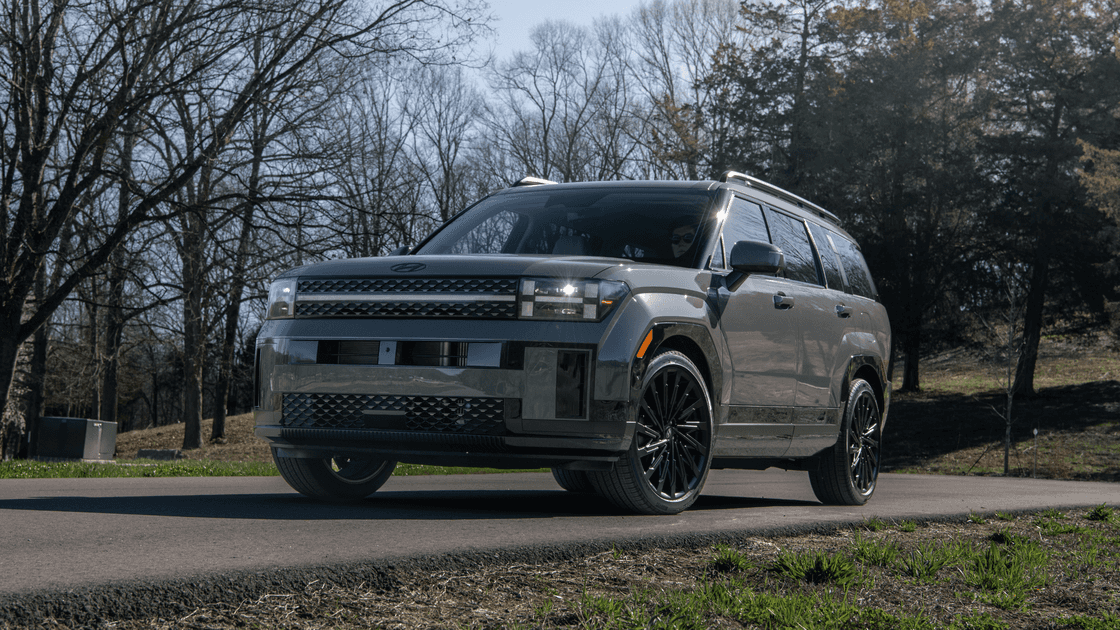
The 2026 Hyundai Santa Fe is engineered as a midsize SUV that prioritizes mechanical integrity, drivetrain versatility, structural strength, and integrated vehicle technologies. Designed around a reinforced unibody platform constructed primarily from high-strength steel, the vehicle balances torsional rigidity with controlled weight distribution. The vehicle is offered in internal combustion and hybrid configurations, each engineered to support specific performance, efficiency, and drivetrain requirements. The 2026 Hyundai Santa Fe lineup also includes specialized configurations intended to support towing, off-road geometry improvements, and expanded ground clearance. All technical systems are designed to operate within standardized emissions and safety compliance requirements for the United States market.
Turbocharged Gasoline and Hybrid Powertrain Architecture
The 2026 Hyundai Santa Fe offers two distinct engine architectures. Gasoline-powered variants utilize a Smartstream® 2.5-liter turbocharged inline four-cylinder engine with dual fuel injection consisting of gasoline direct injection and multi-port injection. This engine features an aluminum block and cylinder head, a compression ratio of 10.5:1, and turbocharging to improve volumetric efficiency. Maximum output is rated at 277 horsepower at 5,800 rpm with peak torque of 311 pound-feet at 4,000 rpm. Torque delivery is tuned to support sustained acceleration under load and stable highway performance.
Hybrid variants integrate a Smartstream® 1.6-liter turbocharged inline four-cylinder gasoline engine with an electric traction motor. The internal combustion engine generates 178 horsepower at 5,500 rpm and 195 pound-feet of torque across a wide operating range. The electric motor contributes an estimated 60 horsepower and 195 pound-feet of torque, resulting in a total combined system output of 231 horsepower and 271 pound-feet of torque. The hybrid system operates using a lithium-ion battery rated at 1.49 kilowatt-hours and a maximum system voltage of 270 volts. Energy recovery is supported through regenerative braking and controlled electric motor engagement at lower speeds.
Both engine systems are engineered to operate on regular unleaded fuel and comply with SULEV30 emissions standards.
Transmission Systems and Torque Management
Gasoline-powered 2026 Hyundai Santa Fe models are paired with an 8-speed automatic transmission engineered to handle higher torque output. Gear ratios are calibrated to balance low-speed torque multiplication with reduced engine load during cruising. Hybrid models utilize a 6-speed automatic transmission designed to integrate seamlessly with electric motor assistance. Both transmissions employ Shift-By-Wire control, which eliminates mechanical linkage between the gear selector and transmission hardware.
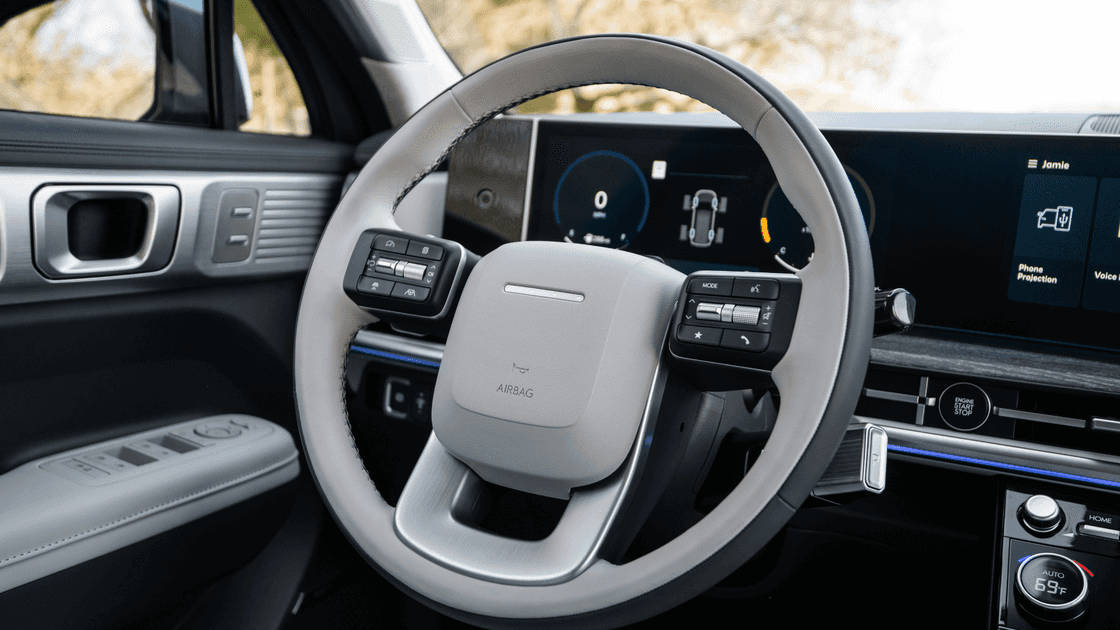
Manual gear control is supported through SHIFTRONIC® paddle shifters mounted on the steering wheel. These paddles allow driver-selected gear engagement while retaining electronic safeguards to protect drivetrain components.
Front-Wheel Drive and HTRAC All-Wheel Drive Systems
The 2026 Hyundai Santa Fe is available in front-wheel drive or with Hyundai HTRAC all-wheel drive. The HTRAC system actively manages torque distribution between the front and rear axles based on the selected drive mode and detected traction conditions. Torque allocation ranges from a front-biased configuration to a fixed 50:50 split when AWD Lock mode is engaged at lower speeds.
Drive modes include Comfort, Eco, Sport, and Smart across all configurations. Snow mode adjusts throttle response and torque delivery to reduce wheel slip. XRT trims add Sand and Mud modes, which modify torque distribution and throttle calibration to support uneven terrain. The AWD system also contributes to improved towing stability and cornering balance under load.
Suspension Geometry and Steering Calibration
The 2026 Hyundai Santa Fe uses a MacPherson® strut front suspension with coil springs and a stabilizer bar. The rear suspension is a multi-link independent design with separated springs and dampers. Gas-pressurized shock absorbers with advanced internal valving are used at all four corners to improve wheel control across varying road surfaces.
Steering is provided through a motor-driven power steering system mounted on the steering column. The rack-and-pinion setup delivers a steering ratio of 13.7:1 with 2.6 turns lock to lock. Turning diameter measures 37.9 feet curb to curb, supporting low-speed maneuverability in confined environments.
Braking Systems and Stability Control
All 2026 Hyundai Santa Fe models are equipped with four-wheel disc brakes. Front brakes use ventilated discs measuring 12.8 inches in diameter, while rear brakes use solid discs of the same diameter. The braking system integrates anti-lock braking, electronic brake-force distribution, brake assist, and vehicle stability management.
Additional features include hill start assist control, downhill brake control, trailer sway control, and an electric parking brake with automatic vehicle hold functionality. Hybrid models utilize an integrated electric brake booster to support regenerative braking performance.
Structural Design and Towing Capability
The 2026 Hyundai Santa Fe is built on a unibody structure designed to manage impact forces through reinforced crumple zones and load paths. The chassis supports a maximum towing capacity of 3,500 pounds for standard gasoline models when equipped with trailer brakes. The XRT configuration increases towing capacity to 4,500 pounds through changes to ground clearance, approach and departure angles, and drivetrain calibration. Hybrid models are rated to tow up to 2,000 pounds with trailer brakes.
All models include trailer pre-wiring and trailer sway control as standard equipment.
Exterior Hardware and Aerodynamic Engineering
Exterior components are designed for durability, visibility, and airflow management. The 2026 Hyundai Santa Fe achieves a coefficient of drag of 0.294. Lighting systems include LED projector headlights, LED daytime running lights, LED taillights, and automatic high beam assist across all trims.
Wheel sizes range from 18 inches to 21 inches depending on configuration, paired with all-season or all-terrain tires. Roof rails are standard and rated to support 220 pounds. Acoustic laminated glass is used for the windshield and front side windows to reduce exterior noise intrusion. A hands-free smart liftgate with adjustable height is standard across the lineup.
Interior Configuration and Dimensional Efficiency
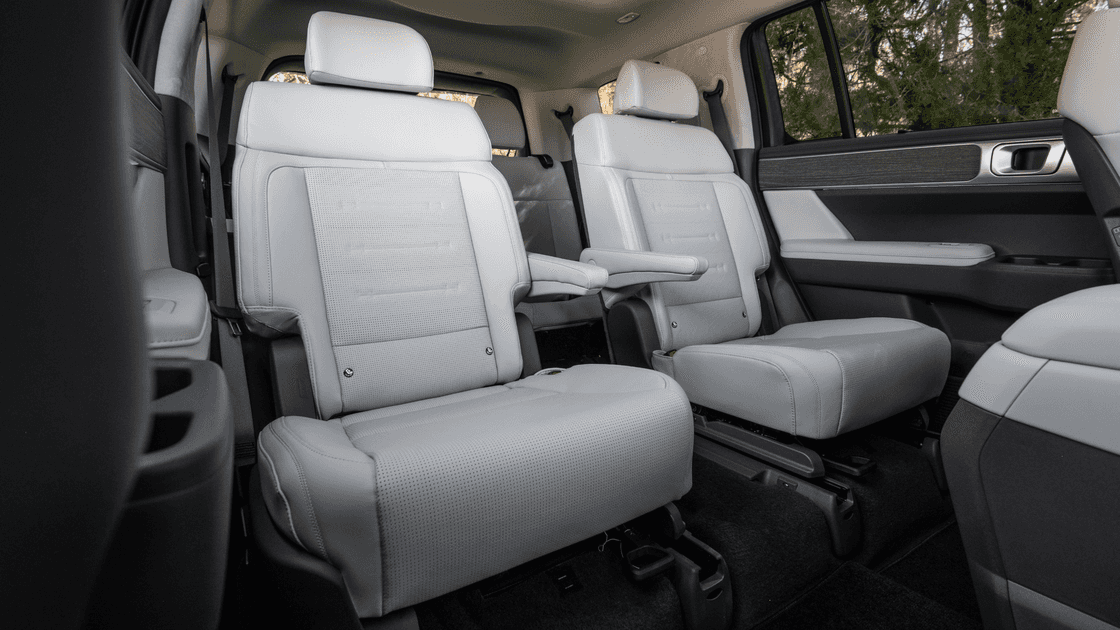
Interior seating configurations support six or seven occupants depending on trim and second-row layout. Seat materials range from stain-resistant cloth to H-Tex® leatherette, leather-trimmed seating, and Nappa leather on higher trims. Front seating options include power adjustment, lumbar support, heating, ventilation, and integrated memory functions.
Second-row seating supports recline and fold-flat operation, while the third row uses a 50:50 folding design with integrated lighting. Total interior volume reaches 166.6 cubic feet, with passenger volume measuring 152.0 cubic feet in gasoline models. Cargo capacity measures 79.6 cubic feet behind the front seats, 40.5 cubic feet behind the second row, and 14.6 cubic feet behind the third row.
Infotainment Systems and Vehicle Interface Technology
The 2026 Hyundai Santa Fe integrates ccNC infotainment architecture from Hyundai. Base systems include a 12.3-inch display audio interface, while higher trims include a 12.3-inch touchscreen with onboard navigation, traffic data, and Wi-Fi hotspot capability. Over-the-air software updating is standard across trims.
Wireless Apple CarPlay® and Android Auto™ are included on all models. Premium trims add a Bose® 12-speaker audio system, surround view monitoring, a windshield-projected head-up display, and wireless device charging with dual charging pads. Hyundai Digital Key 2 Premium allows compatible devices to function as secure vehicle access keys using NFC, BLE, and UWB protocols.
Driver Assistance and Safety Integration
Active safety systems are standard across the 2026 Hyundai Santa Fe lineup. These systems include forward collision-avoidance assist with pedestrian, cyclist, and junction detection; lane keeping assist; lane following assist 2; driver attention warning; and safe exit assist.
Higher trims expand these capabilities with blind-spot collision-avoidance assist, parking collision-avoidance assist, blind-spot view monitoring, remote smart parking assist, and highway driving assist 2. Passive safety systems include multiple airbags, reinforced seatbelt pretensioners, electronic shift lock, immobilizer, and integrated anti-theft systems.
Dimensions, Ground Clearance, and Off-Road Geometry
The 2026 Hyundai Santa Fe rides on a wheelbase of 110.8 inches with an overall length of 190.2 inches. Overall width measures 74.8 inches, and overall height reaches 67.7 inches with roof rails installed. Minimum ground clearance is 7.0 inches, increasing to 8.3 inches on XRT models.
Approach, departure, and ramp breakover angles are optimized on XRT configurations to improve off-road maneuverability. Roof rails support dynamic load capacity while maintaining structural stability.
Visit ALM Hyundai Lumberton to Schedule a Test Ride
Understanding the engineering of the 2026 Hyundai Santa Fe is best achieved through direct evaluation of its power delivery, steering response, and driver-assistance systems. A test drive allows drivers to assess how the turbocharged engines, transmission calibrations, and all-wheel drive system operate together under normal driving conditions. The vehicle’s braking response, ride control, and technology interfaces can be experienced in a controlled environment. Interior layout, visibility, and cargo flexibility are also easier to evaluate in person. Scheduling a test drive with ALM Hyundai Lumberton near Raeford, NC provides the opportunity to examine how the technical systems of the 2026 Hyundai Santa Fe function as an integrated platform rather than as individual components.