

2026 Hyundai Elantra near Raeford, NC
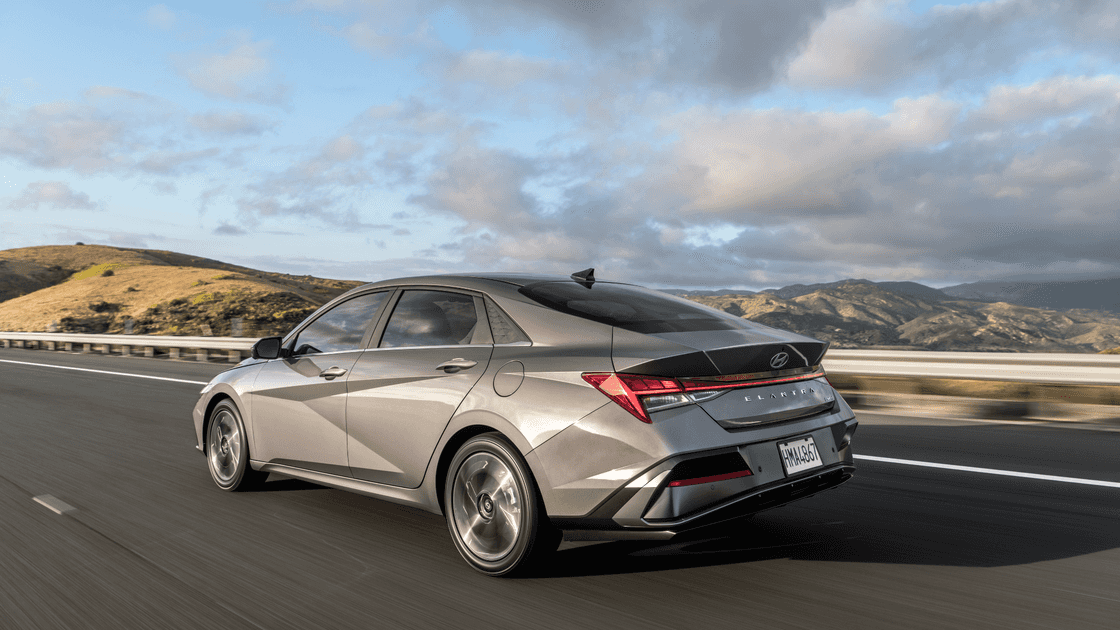
The 2026 Hyundai Elantra is engineered as a compact sedan with a strong emphasis on mechanical variety, structural efficiency, and integrated vehicle systems. The platform supports multiple internal combustion, hybrid, and high-output turbocharged powertrains, allowing the vehicle range to address efficiency-focused, performance-oriented, and balanced daily-driving applications. All variants are built on a unibody structure utilizing high-tensile steel, supporting both torsional rigidity and predictable crash-energy management. The design and engineering direction prioritizes drivetrain flexibility, chassis stability, and standardized safety technology across trims while allowing trim-specific mechanical enhancements.
Engine Architecture and Output Characteristics
The standard gasoline configuration uses a 2.0-liter MPI Atkinson-cycle inline four-cylinder engine with a displacement of 1,999 cubic centimeters. This engine features an aluminum block and head, dual continuously variable valve timing, and a 12.5:1 compression ratio. Output is rated at 147 horsepower at 6,200 rpm and 132 pound-feet of torque at 4,500 rpm. Bore and stroke measurements of 81 millimeters by 97 millimeters reflect a long-stroke design focused on efficiency and mid-range torque consistency. The engine meets LEV3 SULEV30 emissions standards.
Hybrid variants pair a 1.6-liter GDI Atkinson-cycle engine with an electric motor integrated into the drivetrain. The gasoline engine displaces 1,580 cubic centimeters and produces 104 horsepower at 5,700 rpm with 109 pound-feet of torque at 4,000 rpm. Combined system output reaches 139 horsepower and 195 pound-feet of torque. Electrical support is provided by a 240-volt lithium-ion battery with a 1.32 kilowatt-hour capacity. The electric motor alone produces 32 kilowatts, or 43 horsepower, and 125 pound-feet of torque, contributing to low-speed propulsion and regenerative braking functionality.
Turbocharged performance configurations expand the engine lineup. A 1.6-liter Turbo GDI engine with continuously variable valve duration produces 201 horsepower at 6,000 rpm and 195 pound-feet of torque available from 1,500 to 4,500 rpm. The highest-output configuration uses a 2.0-liter turbocharged direct-injection engine with equal bore and stroke dimensions of 86 millimeters. This engine generates 276 horsepower between 5,500 and 6,000 rpm and 289 pound-feet of torque from 2,100 to 4,700 rpm, supporting sustained power delivery across a broad operating range.
Transmission Systems and Driveline Configuration
All 2026 Hyundai Elantra variants use a front-wheel-drive layout. Transmission offerings vary by engine and trim. Efficiency-oriented trims use a Smartstream® Intelligent Variable Transmission designed to maintain optimal engine speed during acceleration and cruising. Turbocharged trims introduce multiple dual-clutch options, including a 6-speed EcoShift® dual-clutch transmission and a 7-speed dry dual-clutch transmission. High-output N Line configurations use an 8-speed wet dual-clutch transmission engineered for thermal stability under higher torque loads.
Manual transmission availability includes a 6-speed manual gearbox for select performance-focused trims. Automatic-equipped variants support SHIFTRONIC® manual shift mode, and paddle shifters are integrated into specific trims. Drive Mode Select functionality allows the driver to adjust throttle mapping, transmission logic, and steering response across modes, including Normal, Sport, Smart, Eco, and N Custom, depending on configuration.
Steering Systems and Suspension Engineering
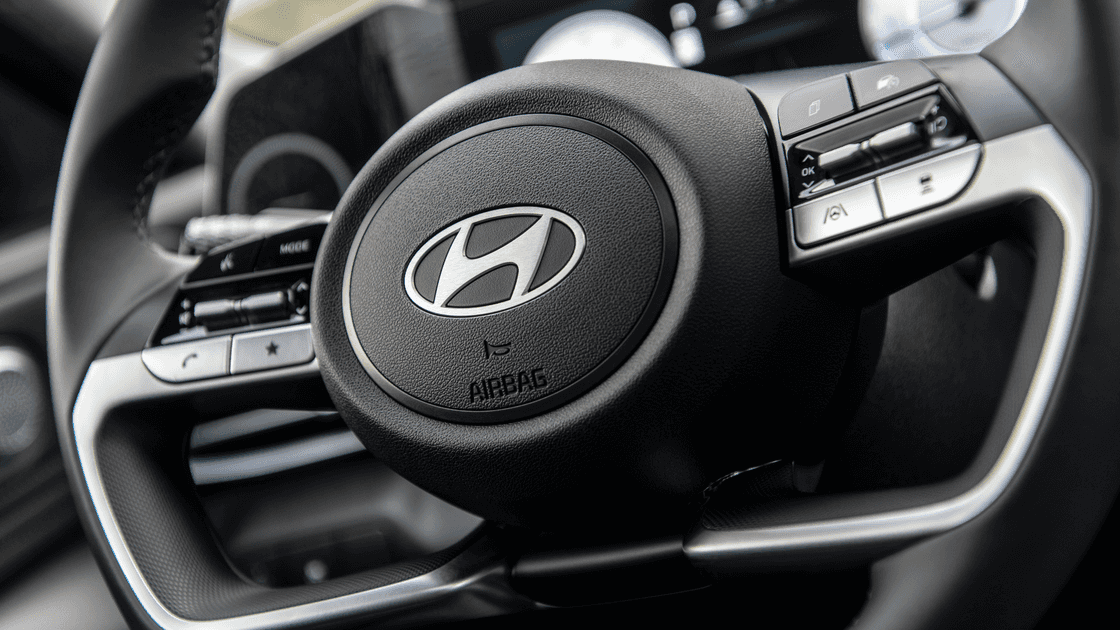
Steering systems differ based on trim level and performance intent. Standard trims use column-mounted motor-driven power steering with a steering ratio of 12.9:1 and a lock-to-lock rotation of 2.5 turns. Performance trims employ rack-mounted motor-driven power steering with a quicker 12.2:1 ratio and 2.2 turns lock to lock. Steering wheel diameter remains consistent at 14.6 inches across the lineup.
Front suspension uses a MacPherson® strut design with coil springs and hydraulic twin-tube shock absorbers. Stabilizer bar thickness varies by trim, ranging from 22 to 23 millimeters. Rear suspension architecture includes a coupled torsion beam axle on standard trims and a multi-link independent rear suspension on higher trims and performance variants. Select configurations include electronic controlled suspension and a rear chassis brace. Performance models also integrate an electronically controlled limited-slip differential designed to manage torque distribution during cornering.
Brake Systems and Vehicle Control Hardware
All trims feature four-wheel disc brakes with anti-lock braking, electronic brake-force distribution, and brake assist functionality. Front brake rotors measure 11.0 inches on standard trims and increase to 14.2 inches on high-performance variants. Rear rotors range from 10.3 inches solid discs to 12.4-inch ventilated discs. Hybrid models incorporate regenerative braking through an electric brake booster, enabling energy recovery during deceleration.
Parking brake systems vary by trim, with mechanical hand lever systems on base trims and electronic parking brakes standard on higher trims. Master cylinder sizing and brake booster specifications are matched to vehicle weight and drivetrain configuration.
Exterior Dimensions and Aerodynamic Considerations
The 2026 Hyundai Elantra has a wheelbase of 107.1 inches, an overall length of 185.4 inches, and an overall width of 71.9 inches. Overall height measures approximately 55.7 inches depending on trim. Minimum ground clearance ranges from 5.3 to 5.5 inches. The coefficient of drag reaches as low as 0.28 on select trims, supporting reduced aerodynamic resistance.
Wheel options range from 15-inch alloy wheels on base trims to 19-inch alloy wheels on performance variants. Tire sizes scale accordingly, with high-performance trims using 245-section summer tires. Exterior lighting systems include LED daytime running lights, dual LED projector headlights, automatic headlamp control, and automatic high-beam assist across most trims.
Interior Dimensions and Seating Specifications
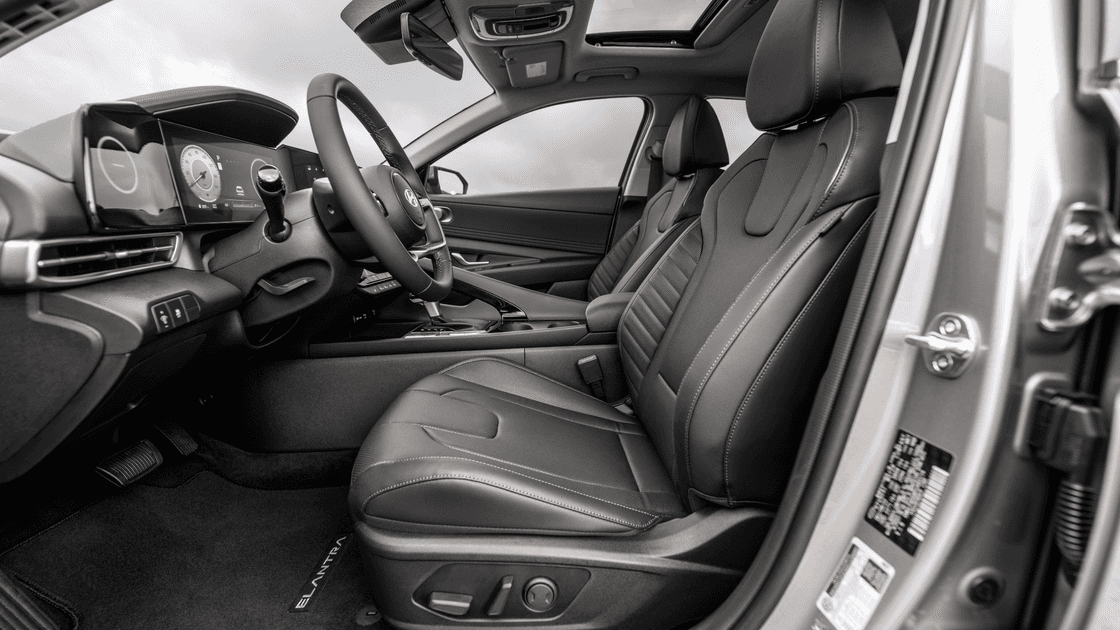
Interior passenger volume measures approximately 99.4 cubic feet. Front headroom measures 40.6 inches without a sunroof and 38.7 inches with a sunroof, while rear headroom measures 37.3 inches. Front legroom measures 42.3 inches, and rear legroom measures 38.0 inches. Shoulder room measures 56.5 inches in front and 55.6 inches in the rear.
Seating capacity is five across all trims. Seat materials vary by configuration and include premium cloth, leatherette, leather-trimmed microsuede, and H-Tex® upholstery. Front seats include six-way driver adjustment and four-way passenger adjustment, with power adjustment, lumbar support, memory settings, heating, and ventilation available on higher trims. Rear seating includes a 60-40 split fold-down seatback with trunk-mounted release levers.
Infotainment, Audio, and Connectivity Systems
Standard infotainment systems include an 8-inch high-resolution touchscreen with AM/FM and HD Radio™ support, wireless Apple CarPlay®, wireless Android Auto™, and a rearview camera with dynamic guidance. Higher trims feature a 10.25-inch navigation system with SiriusXM® capability and integrated data services. Audio systems range from a six-speaker configuration to a Bose® premium system with 8 speakers, including a center channel and subwoofer.
Connectivity features include Bluetooth® hands-free phone integration, dynamic voice recognition, wireless device charging, dual front USB ports, rear USB-C charging ports, and available Wi-Fi hotspot functionality tied to navigation-equipped trims.
Safety Structure and Driver Assistance Technology
All trims include advanced airbag systems, including front, side-impact, and side curtain airbags, along with an occupant classification system and event data recorder. Structural safety features include high-tensile steel reinforcements, front and rear crumple zones, and reinforced door beams.
Active safety systems include forward collision-avoidance assist, blind-spot collision warning with rear cross-traffic collision-avoidance assist, lane keeping assist, lane following assist, driver attention warning, intelligent speed limit assist, and safe exit warning. Higher trims add smart cruise control with stop-and-go functionality and highway drive assist.
Cargo Capacity and Vehicle Mass
Trunk capacity measures 14.2 cubic feet. Total interior and cargo volume reaches approximately 113.6 cubic feet. Fuel tank capacity ranges from 11.0 to 12.4 gallons depending on powertrain. Curb weight ranges from approximately 2,725 pounds for standard gasoline trims to over 3,200 pounds for high-output performance variants. Gross vehicle weight rating varies by configuration and reaches up to 4,178 pounds on select trims.
Visit ALM Hyundai Lumberton near Raeford, NC
A comprehensive understanding of the 2026 Hyundai Elantra is best achieved through direct vehicle evaluation. Experiencing the drivetrain response, braking modulation, and suspension behavior under controlled driving conditions provides clarity on how the technical systems interact. We invite drivers to arrange a scheduled evaluation at ALM Hyundai Lumberton near Raeford, NC to assess engine output, driver assistance technologies, and interior system integration. A guided test drive allows focused examination of steering response, transmission calibration, and safety feature operation. Appointments can be scheduled to ensure adequate time for technical review and vehicle familiarization.