

2026 Hyundai Elantra near Fayetteville, NC
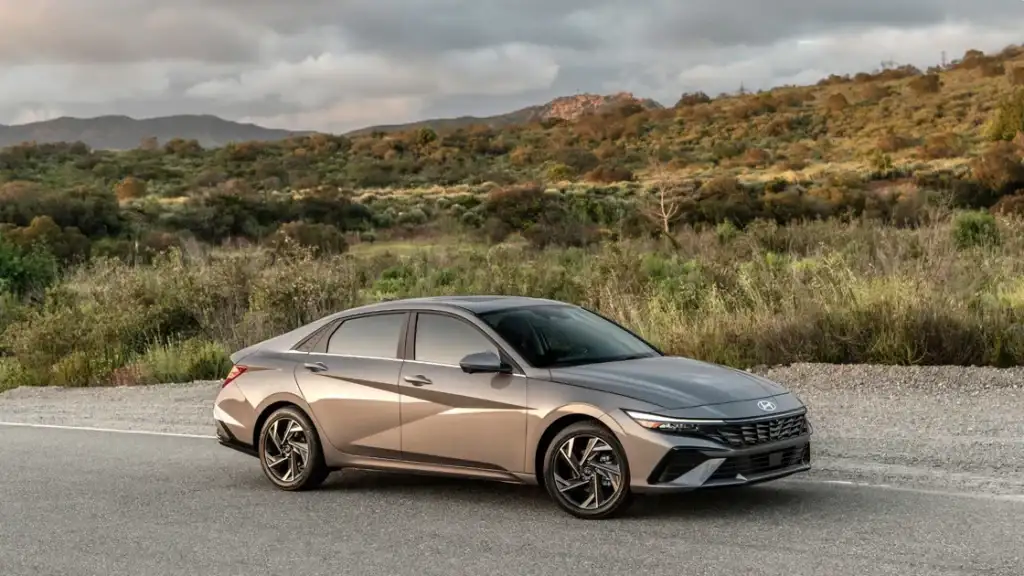
The 2026 Hyundai Elantra demonstrates a continued commitment to engineering precision, efficiency, and design advancement. Built on a unibody frame composed primarily of high-tensile steel, this compact sedan integrates powertrain versatility, intelligent aerodynamics, and refined driving technology. Each trim in the lineup incorporates systems designed for consistent performance, energy management, and driver assistance accuracy.
Engine Design and Mechanical Configuration
The 2026 Hyundai Elantra is engineered with four main powertrain variations, each serving distinct performance and efficiency functions.
The SE and SEL trims operate with a 2.0-liter Multi-Point Injection Atkinson Cycle DOHC 16-valve inline four-cylinder engine with an aluminum block and head. It displaces 1,999 cubic centimeters, producing 147 horsepower at 6,200 revolutions per minute and 132 pound-feet of torque at 4,500 revolutions per minute. The system uses dual continuously variable valve timing and a 12.5:1 compression ratio for precise combustion control.
Hybrid trims feature a 1.6-liter Gasoline Direct Injection Atkinson Cycle 16-valve inline four-cylinder paired with an electric motor. The gasoline engine produces 104 horsepower and 109 pound-feet of torque, while the combined hybrid system generates 139 horsepower and 195 pound-feet of torque. This system operates with a 240-volt lithium-ion battery rated at 1.32 kilowatt-hours, delivering energy through an interior permanent magnet synchronous motor.
For increased output, the N Line trim introduces a 1.6-liter Turbocharged GDI engine with continuously variable valve duration. It produces 201 horsepower at 6,000 revolutions per minute and 195 pound-feet of torque between 1,500 and 4,500 revolutions per minute. It includes an aluminum block and head and a 10.0:1 compression ratio.
The highest output option is the 2.0-liter turbocharged direct-injected “Flat Power” four-cylinder featured in the Elantra N trim. It generates 276 horsepower between 5,500 and 6,000 revolutions per minute with 289 pound-feet of torque available from 2,100 to 4,700 revolutions per minute. The 9.5:1 compression ratio and optimized turbocharging enhance sustained acceleration under load.
All engines employ low-emission systems such as LEV3 SULEV30 or LEV3 ULEV70 compliance depending on configuration, with optimized exhaust routing and catalytic converter design. The intake system uses variable charge motion and two-step variable induction for efficient air control.
Transmission Engineering and Drive Configuration
Front-wheel drive is standard across the 2026 Hyundai Elantra lineup. Each variant uses a transmission system matched to its engine characteristics to achieve smooth power delivery and fuel economy consistency.
The SE and SEL trims use the Smartstream® Intelligent Variable Transmission from Hyundai. This system automatically adjusts ratio progression for steady acceleration and reduced fuel consumption. Hybrid models operate with a six-speed EcoShift® dual-clutch transmission that coordinates electric and gasoline torque through precise electronic synchronization.
The N Line model features a seven-speed dry dual-clutch transmission identified as code D7UF1. This configuration provides rapid shift timing with minimal energy loss. The N variant introduces an eight-speed wet dual-clutch transmission using an advanced diaphragm spring design to manage heat dissipation under extended performance conditions.
Each configuration includes Drive Mode Select with Normal, Sport, and Smart settings, while the N trim expands functionality to include Eco and customizable N modes for fine control of throttle response, steering input, and transmission mapping.
Suspension, Steering, and Braking Systems
The 2026 Hyundai Elantra uses a combination of suspension geometries to balance stability and comfort. The front structure is a MacPherson® strut system with a 22 to 23 millimeter hollow stabilizer bar and hydraulic twin-tube shock absorbers. The rear suspension varies by trim. SE and SEL models use a coupled torsion beam axle design with gas-filled monotube shocks, while higher trims and hybrid models use a multi-link independent layout with stabilizer bars ranging from 17 to 24 millimeters in diameter. The Elantra N trim employs an electronically controlled suspension system with rear chassis bracing and an electronically managed limited-slip differential for enhanced cornering traction.
Steering response is controlled through either a column-mounted or rack-mounted motor-driven power steering unit, depending on trim. Steering ratios range from 12.9:1 to 12.2:1, and lock-to-lock rotation measures between 2.5 and 2.2 turns. The minimum turning radius ranges from 17.7 to 19.2 feet, contributing to maneuverability across environments.
Braking performance incorporates ventilated front discs up to 14.2 inches in diameter and solid or ventilated rear discs up to 12.4 inches. The N variant uses 13.6-inch front and 12.4-inch rear rotors. All trims are equipped with four-channel anti-lock braking, electronic brake-force distribution, brake assist, and a tandem master cylinder system. Electric parking brakes are available from the SEL Sport Premium level and higher.
Exterior Design and Aerodynamics
The 2026 Hyundai Elantra features a low, aerodynamic profile with a coefficient of drag as low as 0.28 depending on configuration. It measures 185.4 inches in length, 71.9 inches in width, and 55.7 inches in height with a 107.1-inch wheelbase. The minimum ground clearance ranges from 5.3 to 5.5 inches.
Wheel options range from 15-inch alloy wheels on SE trims to 19-inch alloys on the N model. Tire specifications vary from 195/65R15 to 245/35R19, including Hankook Ventus S1 all-season tires and Michelin® Pilot Sport 4 S summer tires on performance models. Lighting technology includes standard LED daytime running lights, dual LED projector headlights, and automatic high beam assist. Full LED rear taillights are standard on the N trim.
The exterior integrates solar glass, gloss or matte black grilles, and body-colored handles. Sport-oriented versions feature gloss black rear diffusers and spoilers, while the N trim includes a wing-type spoiler and larger exhaust outlets for improved flow and heat management.
Interior Architecture and Systems
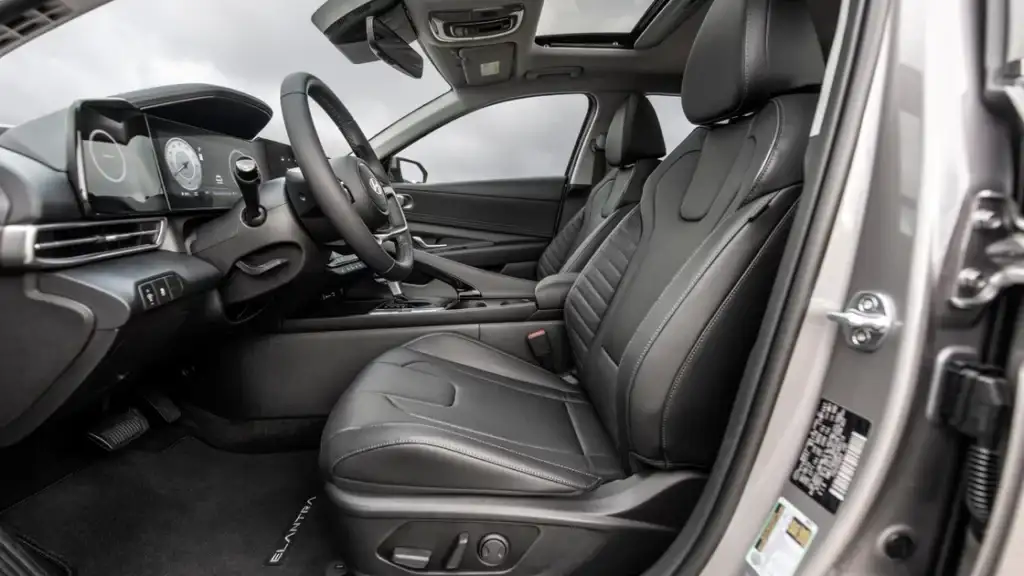
The interior of the 2026 Hyundai Elantra combines structural simplicity with functional technology. Seating capacity remains five passengers. Headroom measures up to 40.6 inches in the front and 37.3 inches in the rear. Legroom measures 42.3 inches in the front and 38.0 inches in the rear. Shoulder room extends 56.5 inches in the front and 55.6 inches in the rear.
Premium cloth is standard across SE and SEL trims, while hybrid and upper-level models use H-Tex® leatherette or leather-trimmed sport seats. The N variant features leather and microsuede sport bucket seats with integrated illumination. Available seat functions include heating, ventilation, power adjustment with lumbar support, and memory configuration for the driver’s seat and mirrors.
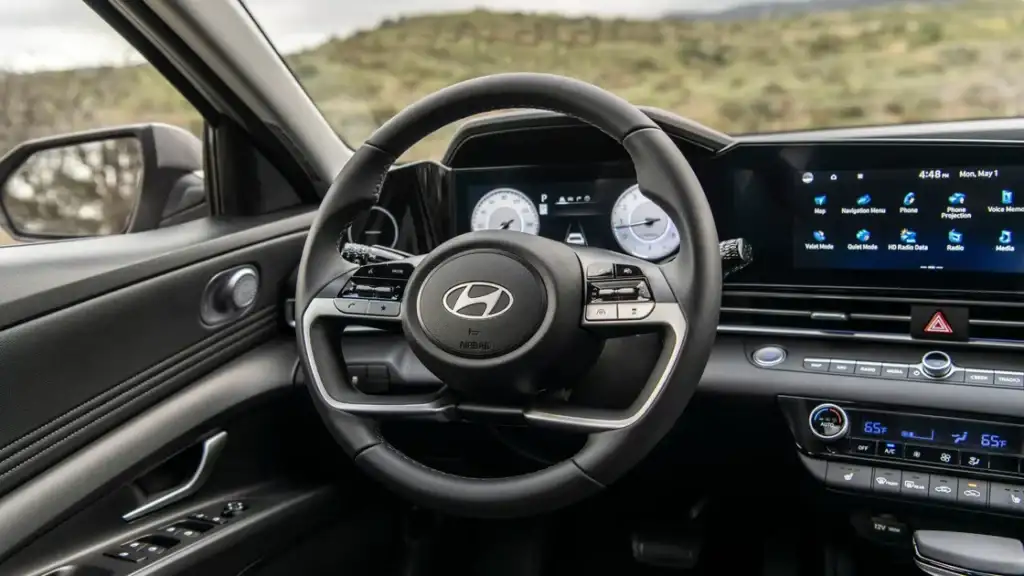
Interior technology integrates either an 8-inch display audio system or a 10.25-inch navigation display, depending on trim. Both include AM, FM, HD Radio™, and wireless Apple CarPlay® and Android Auto™. Limited and N trims feature Bose® premium audio with eight speakers, including a center channel and subwoofer. Connectivity options include Bluetooth® with voice recognition, dual front and rear USB-C ports, Qi wireless charging, and Wi-Fi hotspot capability through the navigation interface.
Climate control systems range from manual air conditioning to dual automatic temperature control with rear seat heater ducts and a rear window defroster. Convenience functions include a proximity key system with push-button start, hands-free trunk release, and Digital Key 2.0 access. Auto-dimming mirrors and integrated HomeLink compatibility are available on upper trims.
Integrated Safety and Assistance Systems
Every 2026 Hyundai Elantra trim includes an array of safety systems designed to enhance situational control and occupant protection. Passive systems include front, side, and curtain airbags, reinforced crumple zones, and body-side reinforcements. Each model includes three-point seatbelts for all occupants with front pretensioners and adjustable shoulder anchors.
Active safety systems standardize anti-lock braking, electronic stability control, traction control, and hill-start assist. Driver-assistance features under Hyundai SmartSense include Forward Collision-Avoidance Assist with pedestrian detection, Lane Keeping Assist, Lane Following Assist, Driver Attention Warning, and Intelligent Speed Limit Assist.
Enhanced systems available on higher trims include Forward Collision-Avoidance Assist with pedestrian, cyclist, and junction-turning detection; Smart Cruise Control with Stop and Go; Blind-Spot Collision Warning with Rear Cross-Traffic Collision-Avoidance Assist; Highway Drive Assist; and Safe Exit Warning with Rear Occupant Alert. The N trim also includes front and rear parking distance warnings and available camera-based guidance for precision maneuvering.
Dimensions and Capacities
The 2026 Hyundai Elantra maintains consistent dimensions across trims with practical cargo and fuel capacities. Passenger volume measures 99.4 cubic feet, and trunk space measures 14.2 cubic feet for a total interior volume of 113.6 cubic feet. Curb weight varies from 2,725 to 3,296 pounds depending on drivetrain and trim. Fuel capacity is 12.4 gallons for gasoline models and 11.0 gallons for hybrid variants.
Schedule a Test Ride near Fayetteville, NC
The 2026 Hyundai Elantra combines engineering precision with modern systems integration. Each model delivers measurable performance through advanced engines, efficient transmission technology, adaptive suspension design, and a comprehensive safety suite. To experience these technical features directly, schedule a test drive with ALM Hyundai Lumberton near Fayetteville, NC. Discover how optimized powertrains, advanced digital connectivity, and reinforced safety engineering define the 2026 Hyundai Elantra.